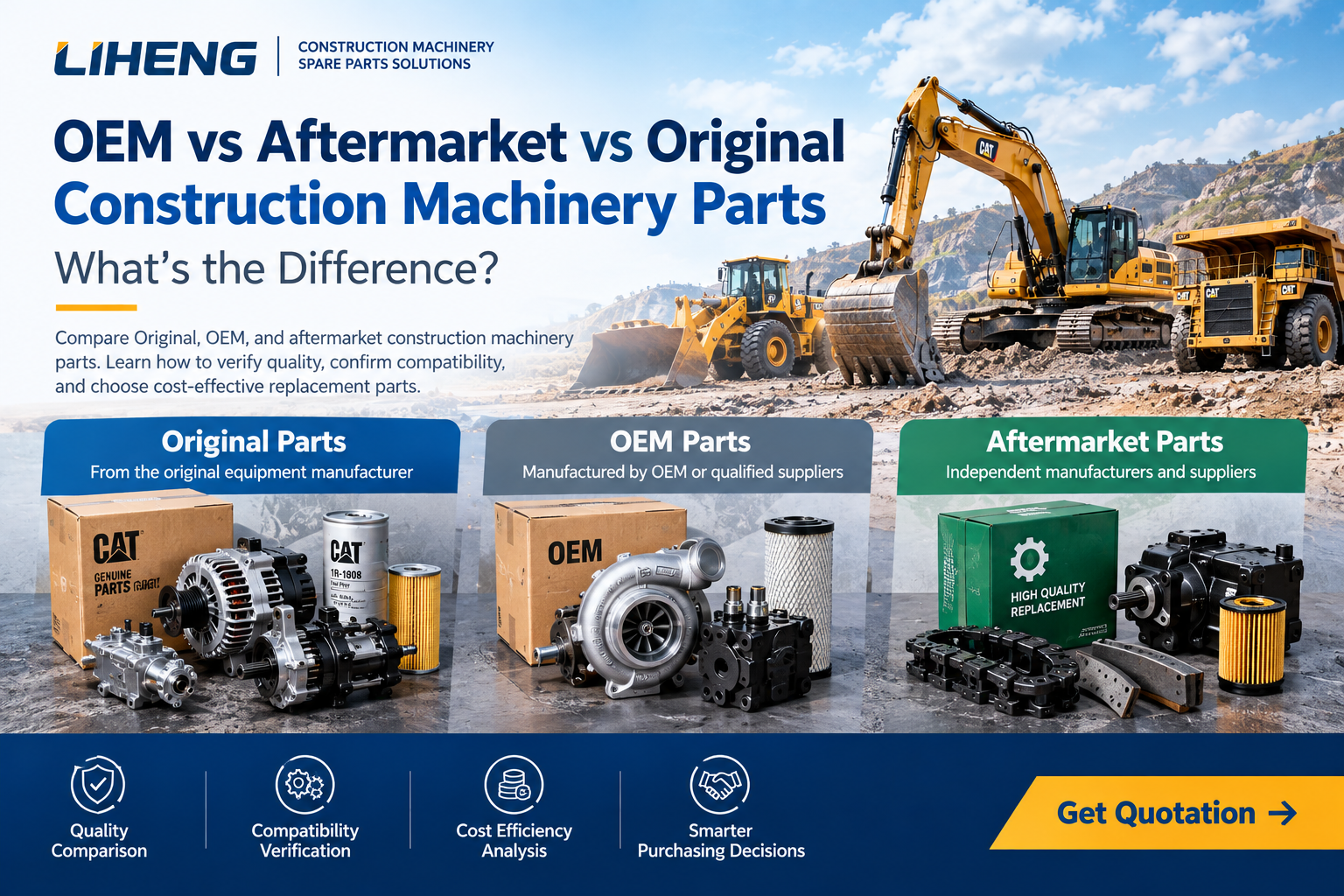
Learn the differences between Original, OEM, and aftermarket construction machinery parts. Discover how to verify compatibility, compare suppliers, evaluate quality, and choose cost-effective replacement parts for excavators, loaders, and mining equipment.
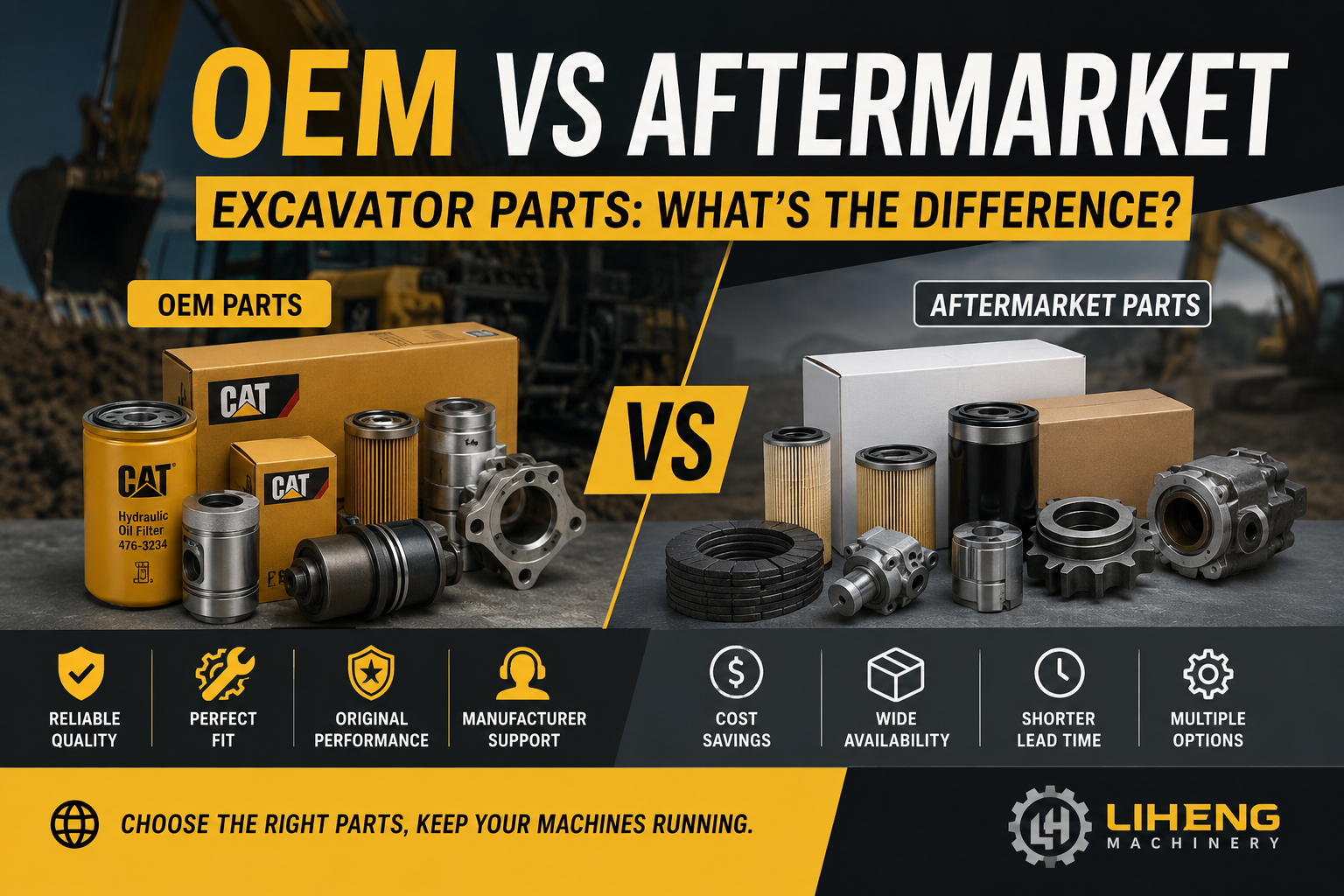
When sourcing construction machinery spare parts, international buyers often face the same question: Should you choose Original, OEM, or aftermarket parts?
The answer depends on the component, equipment application, operating conditions, budget, and availability.
For excavators, wheel loaders, bulldozers, mining trucks, drilling rigs, and underground LHD loaders, choosing the wrong replacement part can lead to installation problems, repeated repairs, unexpected downtime, and additional costs.
However, paying more does not automatically guarantee a better purchasing decision. A suitable replacement part from a qualified manufacturer may offer good value, while an inexpensive component with unverified specifications can create unnecessary risks.
In this guide, LIHENG Machinery explains the differences between Original, OEM-described, and aftermarket parts, how to evaluate replacement options, and what to verify before ordering from a Chinese supplier.
1. What Are Original Construction Machinery Parts?
Original parts are supplied through the original equipment manufacturer’s parts system or its authorized distribution channels.
These parts are intended for specified equipment applications and can generally be identified through the manufacturer’s parts catalogue and applicable part numbers.
For example, when maintaining a CAT excavator or Volvo wheel loader, a buyer may choose Original parts to follow the equipment manufacturer’s maintenance recommendations.
Advantages of Original Parts
Equipment compatibility: Original parts are identified for specific applications, although buyers should still verify the correct part number and machine serial number.
Product traceability: Purchases through appropriate channels may provide clearer documentation of product origin and supply channels.
Manufacturer support: Depending on the purchasing channel, buyers may have access to applicable technical information and warranty support.
Potential Limitations
Original parts may have higher purchase prices than alternative products. Availability and lead times also depend on the component, location, and distribution channel.
For buyers managing multiple equipment brands, sourcing every component through individual Original channels can increase purchasing complexity.
When Should You Choose Original Parts?
Original parts may be preferable when:
The equipment manufacturer specifically recommends them.
The component has strict compatibility requirements.
Product traceability is particularly important.
The consequences of component failure are significant.
Original supply channels provide important technical or warranty support.
The right decision should reflect the component’s function and the operating requirements of the equipment.
2. What Does OEM Mean in the Spare Parts Industry?
OEM stands for Original Equipment Manufacturer.
However, the term is not always used consistently in the international spare parts market.
Depending on the supplier and context, OEM may refer to an original equipment manufacturer, a component manufacturer supplying an equipment manufacturer, or a product described as meeting certain manufacturing specifications.
These meanings are not interchangeable.
A product advertised as OEM does not automatically mean that it was manufactured by the original equipment manufacturer, supplied to that manufacturer, or officially approved by the machinery brand.
What Should Buyers Verify?
Before purchasing a product described as OEM, ask the supplier:
Who is the actual manufacturer?
Is there evidence of the claimed manufacturing relationship?
What technical specifications does the product meet?
Is it compatible with the specific machine and serial number?
What documentation and warranty are available?
A supplier’s description alone is not sufficient evidence of manufacturing origin or equivalence.
When Should You Consider OEM-Related Products?
Consider these products when the manufacturer, specifications, compatibility, and supporting documentation can be verified.
The important point is to evaluate the actual product rather than relying exclusively on the OEM label.
3. What Are Aftermarket Construction Machinery Parts?
Aftermarket parts are supplied outside the original equipment manufacturer’s parts distribution system. They may be produced by independent manufacturers or distributed by replacement-parts suppliers.
They cover a broad range of products, including:
Engine components
Hydraulic pumps and valves
Filters and maintenance parts
Belts and hoses
Electrical components
Cooling system parts
Undercarriage components
Transmission and drivetrain parts
Mining equipment spare parts
Aftermarket quality varies by manufacturer, product category, and application. Some replacement parts offer reliable performance, while others may not meet the required technical or durability standards.
Therefore, aftermarket parts should be evaluated individually rather than treated as a single quality category.
Advantages of Aftermarket Parts
Competitive pricing
Some aftermarket products cost less than Original alternatives, helping buyers manage purchasing budgets.
Greater sourcing flexibility
Independent manufacturers can provide alternative options when Original parts are expensive, difficult to obtain, or subject to long lead times.
Multiple supplier options
Buyers may compare products from different manufacturers to identify a suitable balance between price, quality, and availability.
Risks to Consider
The main risks include inconsistent quality, unclear manufacturing origins, incorrect dimensions, incompatible specifications, and different warranty conditions.
A replacement part that looks similar to the original may still differ in important technical characteristics.
How to Evaluate an Aftermarket Part
Before ordering, request the following information whenever applicable:
Exact part number and equipment application.
Manufacturer or brand.
Product photos and identification markings.
Relevant dimensions and technical specifications.
Compatibility confirmation.
Quality inspection information.
Warranty terms.
Actual availability and lead time.
For critical or technically complex components, additional engineering verification may be necessary.
A competitive price is valuable only when the product is suitable for the intended application.
4. Original vs OEM vs Aftermarket: Key Differences
Comparison | Original Parts | OEM-Described Products | Aftermarket Parts |
|---|---|---|---|
Supply channel | Original manufacturer’s parts system or authorized channels | Depends on the actual manufacturer and supplier’s claim | Independent manufacturers and replacement-parts suppliers |
Manufacturing origin | Should be supported by appropriate sourcing documentation | Requires verification | Requires verification |
Compatibility | Confirm part number and machine application | Confirm specifications and compatibility | Confirm specifications and compatibility |
Price | Often higher | Varies | Often competitive, but varies |
Supplier selection | Depends on the original distribution network | Depends on the manufacturer and supplier | May offer more sourcing options |
Warranty | Depends on the applicable channel and terms | Depends on the product and supplier | Depends on the product and supplier |
Main consideration | Correct identification and supply-channel verification | Confirm the meaning of OEM and verify the manufacturer | Assess quality, compatibility, and manufacturer reliability |
These categories should not be treated as a universal ranking of product quality. Actual performance depends on the product’s design, materials, manufacturing process, inspection, and suitability for the application.
5. How to Choose the Right Part for Different Applications
Different components have different technical requirements. The most suitable purchasing strategy depends on the part’s function and the consequences of failure.
Engine Parts
Engine components such as pistons, bearings, injectors, fuel pumps, and cylinder-head parts require careful verification.
Confirm the engine model, part number, applicable specifications, and manufacturer before purchasing.
For critical engine components, prioritize verified compatibility and reliable product information over price alone.
Hydraulic Components
Hydraulic pumps, control valves, hydraulic motors, and related components must meet the equipment’s technical requirements.
Depending on the component, buyers may need to verify:
Operating pressure and flow.
Mounting dimensions.
Port configuration.
Rotation direction.
Control characteristics.
Machine model and serial number compatibility.
Do not assume that a component is interchangeable simply because it looks similar or has a similar part number.
Electrical Components
Sensors, controllers, switches, and electric motors may differ in voltage, connector type, wiring, control signals, or software compatibility.
Confirm the exact specifications and applicable equipment version before ordering.
Filters and Routine Maintenance Parts
Filters, belts, and other routine maintenance items may offer more replacement options, but specifications still matter.
Check the dimensions, connection type, filtration requirements where applicable, and the manufacturer’s recommended service requirements.
Mining and Underground Equipment Parts
Mining equipment often operates under heavy loads, vibration, dust, and demanding working schedules.
For large mining excavators, underground LHD loaders, mining trucks, and drilling rigs, evaluate the component’s operating conditions, expected service requirements, availability, and the potential cost of downtime.
For critical applications, documented quality and compatibility should take priority over an unverified low-cost alternative.
6. A Practical Example: Replacing a Hydraulic Pump
Consider a buyer who needs a replacement hydraulic pump for an excavator.
The buyer receives three quotations:
Option A: An Original part.
Option B: A replacement product described as OEM.
Option C: An aftermarket replacement from an independent manufacturer.
Comparing the prices alone is not enough.
Before making a decision, the buyer should ask:
Step 1: Confirm the part number
Check the machine model, serial number, original part number, and any documented superseded part numbers.
Step 2: Verify the actual manufacturer
For the OEM-described option, clarify who manufactures the pump and what evidence supports the supplier’s description.
For the aftermarket option, request the manufacturer’s identity and available product documentation.
Step 3: Compare technical specifications
Check the relevant pressure, flow, mounting dimensions, port configuration, and control characteristics.
The exact requirements depend on the hydraulic system.
Step 4: Review the commercial terms
Compare unit price, lead time, warranty, packaging, shipping terms, and availability.
Step 5: Assess the consequences of failure
If an incorrect pump could cause extensive downtime or damage other components, the value of reliable technical verification may outweigh a modest difference in purchase price.
The result may be different for different machines and operating conditions. The objective is to select a verified, suitable product—not automatically the cheapest or most expensive one.
7. How to Compare Total Cost, Not Just Purchase Price
The initial purchase price is only one part of the total cost of a spare part.
A practical decision-making framework is:
Total Cost of Ownership = Purchase Cost + Logistics Cost + Installation Cost + Expected Failure Cost + Downtime Cost
This is a simplified framework rather than a precise accounting formula, but it highlights an important point.
A lower-priced part may become more expensive if it has a shorter service life, requires repeated replacement, or causes significant equipment downtime.
For example:
Cost Item | Option A | Option B |
|---|---|---|
Purchase price | $300 | $450 |
Estimated freight and handling | $40 | $40 |
Initial cost | $340 | $490 |
Option A has a lower initial cost.
However, if Option A has a higher failure risk or shorter service life, the initial savings may be offset by additional labor, replacement purchases, and downtime.
This does not mean Option B is automatically better. Its quality and expected service life must also be supported by credible evidence.
Compare the available information and choose the option that best meets your technical and operating requirements.
8. Eight Questions to Ask a Chinese Spare Parts Supplier
Before confirming an order, ask the supplier these questions.
1. Can you confirm the exact part number?
Provide the machine model, serial number, and original part number whenever possible.
2. Who manufactures the product?
Ask for the manufacturer’s name and available supporting documentation.
3. What does the quality description mean?
Clarify whether the product is Original, described as OEM, or an aftermarket replacement.
4. Can you verify compatibility?
For complex components, provide photos, nameplate information, technical drawings, or other identifying details.
5. Is the product in stock?
Confirm actual availability and the estimated dispatch date.
6. What warranty is provided?
Check the warranty period, coverage, exclusions, and claim procedure.
7. Can you provide actual product photos?
For important components, request photos showing the product, markings, nameplate, and packaging where applicable.
8. Can you coordinate export and shipment?
Confirm the quotation terms, packaging, export documents, shipping arrangements, and any other requirements relevant to the destination.
A professional supplier should explain the available information clearly and identify any details that still require confirmation.
9. Why a Multi-Supplier Sourcing Network Matters
International buyers often need different parts for several machine brands and equipment types.
For example, a mining contractor may need engine components for one machine, hydraulic parts for another, and electrical components for a third.
These products may come from different specialized manufacturers across China.
Contacting every manufacturer individually can increase the time and effort required for product identification, quotation comparison, order coordination, and shipment management.
A capable sourcing partner can help buyers:
Identify the correct part number.
Find suitable Chinese supply sources.
Compare Original and aftermarket options.
Verify product information and specifications.
Compare prices and lead times.
Coordinate quality checks.
Consolidate purchases from multiple suppliers.
Coordinate export documentation and shipment arrangements.
A sourcing partner’s value is not simply access to a lower quotation. It is the ability to help buyers evaluate options and manage the purchasing process more efficiently.
For more guidance, read our related article: How to Find Reliable Construction Machinery Spare Parts Suppliers in China.
10. How LIHENG Machinery Helps Buyers Source Spare Parts from China
Guangzhou LIHENG Machinery supports international buyers sourcing construction and mining machinery spare parts from China.
Our sourcing approach focuses on matching each requirement with a suitable supply source rather than assuming that one manufacturer can provide every component.
We assist with sourcing for:
Excavators and wheel loaders.
Bulldozers and dump trucks.
Engine systems.
Hydraulic systems.
Electrical and cooling systems.
Mining excavators.
Underground LHD loaders.
Mining trucks and drilling rigs.
Depending on the specific product, we can help investigate Original and aftermarket supply options, compare quotations, check available product information, and coordinate purchasing and export arrangements.
For difficult-to-identify components, buyers can provide the part number, machine model, nameplate, or original product photos to help us investigate the requirement.
Our goal is to help customers make informed sourcing decisions based on compatibility, quality requirements, availability, and budget.
Frequently Asked Questions
Are aftermarket construction machinery parts reliable?
Some aftermarket parts can provide reliable performance, but quality varies by manufacturer and product. Verify technical specifications, compatibility, manufacturing information, quality-control procedures, and warranty terms before purchasing.
Are OEM parts the same as Original parts?
Not necessarily. OEM is used in different ways in the spare parts industry. A product described as OEM is not automatically an Original-branded part or a product manufactured by the original equipment manufacturer. Verify the actual manufacturer and supporting documentation.
Are aftermarket parts always cheaper than Original parts?
No. Prices vary by product, manufacturer, availability, and quality. Compare the complete quotation, including freight, lead time, warranty, and other relevant costs.
Can aftermarket parts replace Original parts?
Some aftermarket parts can be suitable replacements if they meet the technical requirements and are compatible with the specific equipment. Confirm compatibility before ordering or installation.
How can I identify the correct replacement part?
Start with the part number, machine model, and serial number. For complex components, provide photos, nameplate information, technical drawings, or other identifying details.
Which parts should I purchase through Original channels?
Consider Original parts when manufacturer recommendations, strict compatibility requirements, traceability, or the consequences of failure make them the preferred option. The decision should also reflect the component’s function and the available alternatives.
Can I use Original and aftermarket parts on the same machine?
In some cases, yes. Evaluate each component individually and confirm compatibility, technical requirements, and applicable manufacturer recommendations.
Conclusion: Choose the Right Part for the Right Application
Original, OEM-described, and aftermarket construction machinery parts each have different purchasing considerations.
Original parts may be appropriate when established manufacturer channels and specific equipment requirements are priorities. OEM-related claims require careful verification. Aftermarket parts can offer competitive alternatives when product quality, specifications, and compatibility are properly evaluated.
The best purchasing decision is not always the most expensive or the cheapest option.
It is the option that meets your technical requirements, provides acceptable reliability, and delivers the best overall value for your equipment and operating conditions.
Need help sourcing construction or mining machinery spare parts from China?
Send your part number, machine model, product photos, or parts list to LIHENG Machinery. We can help investigate available supply options and provide a quotation based on your requirements.